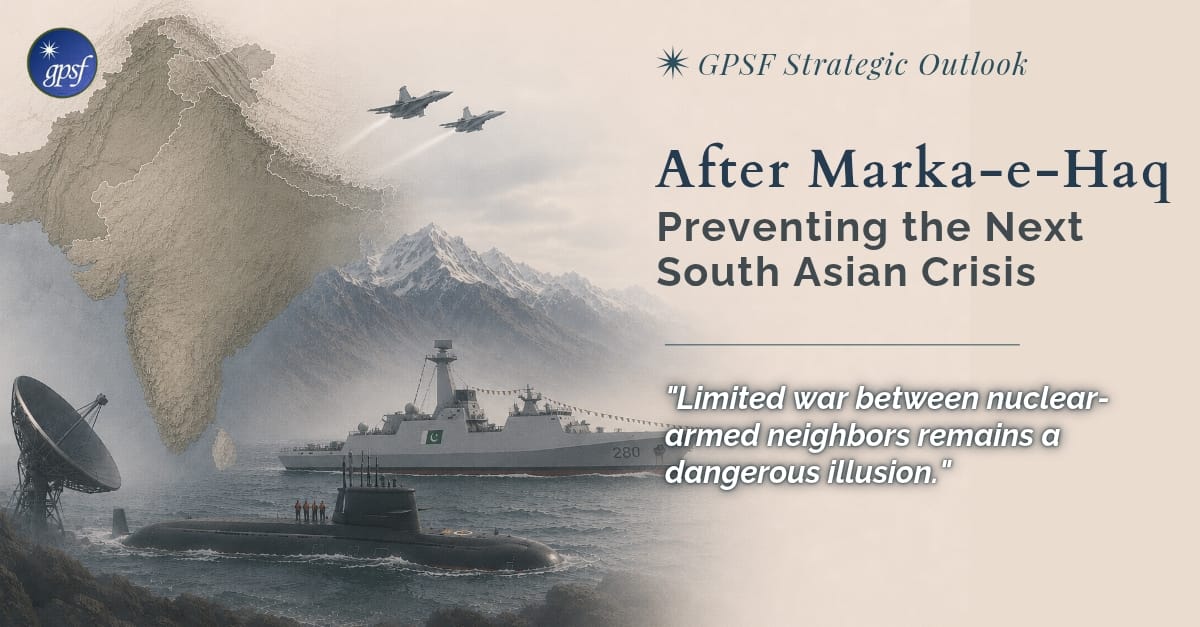
After Marka-e-Haq: Preventing the Next South Asian Crisis
The May 2025 India-Pakistan conflict, though compressed into four intense days, marked a consequential turning point in South Asian deterrence. Pakistan's Marka-e-Haq, culminating in Operation Bunyanum Marsoos, did more than answer India's Operation Sindoor; it exposed the fragility of the assumption that limited war can be safely initiated, calibrated, and concluded under the nuclear shadow. One year later, the central policy question is whether South Asia can absorb the lessons of that crisis before the next one unfolds under even more dangerous conditions.
The Illusion of Limited War
India had sought to present Operation Sindoor as the basis of a so-called new normal: another failed dangerous attempt in which limited stand-off strikes could be conducted below the nuclear threshold, coercive punishment imposed unilaterally, and military action undertaken without meaningful consequences. This premise was inherently unstable. In a nuclearized dyad, one side cannot reserve for itself the right to use force while denying the other the right to respond. Any attempt to normalize war without consequence is bound to invite counteraction, compress decision time, and heighten escalation risks.
Deterrence Restored
Pakistan's response demonstrated precisely that. Operation Bunyanum Marsoos combined speed, precision, political control, and strategic restraint. It neutralized India's claims without resorting to indiscriminate or massed salvos and restored conventional deterrence through calibrated force. The strategic message was clear: the imagined space for limited war in South Asia does not exist. Attempts at compellence will attract resistance, and stronger resistance than reward.
A Compressed Battlespace
The crisis also highlighted the changing character of deterrence itself. Across the air, land, maritime, cyber, electronic, information, diplomatic, and psychological domains, May 2025 compressed South Asia's structural vulnerabilities into a single, dangerously shortened decision cycle. Unresolved disputes, coercive doctrines, technological acceleration, and narrative warfare all interacted within an environment already burdened by nuclear risk. Future crises may therefore unfold faster than facts can be established, faster than diplomacy can mobilize, and faster than responsible voices can intervene. Thus, as GPSF observed in its post-May 2025 analysis of South Asian crisis behavior, the May 2025 India-Pakistan crisis marked a consequential inflection point in South Asian security dynamics.
The Unresolved Core
At the heart of this instability remain the unresolved territorial disputes, above all Jammu and Kashmir. Like earlier crises, May 2025 confirmed that Kashmir cannot be bypassed in any serious discussion of regional stability. So long as territorial disputes remain unsettled, local incidents will continue to carry the risk of wider escalation. India's subsequent effort to place the Indus Waters Treaty under political pressure has widened this danger further. Weaponizing water blurs the line between peace and conflict, converts a humanitarian treaty into an instrument of coercion, and links environmental insecurity with strategic instability. For Pakistan, any deliberate obstruction of Indus waters would be treated as a strategic matter, not a routine bilateral disagreement.
Brinkmanship Ahead
These developments also expose the inadequacy of existing crisis-management arrangements. The most serious future danger lies in routinizing brinkmanship through renewed adventures such as an imagined Operation Sindoor 2.0. Drones, cyber operations, precision fires, and space-enabled surveillance now compress timelines and complicate attribution. Cyber and space integration also raise the risk of nuclear entanglement, particularly where conventional and strategic systems rely on overlapping networks. In such an environment, the decisive question may be less about who owns the faster platform than who retains sound human judgment when technology accelerates the tempo of conflict.
Maritime Spillover
India's continued suggestion that Operation Sindoor has not ended, including threats to widen future conflict into the maritime domain, compounds these risks. The Arabian Sea is not an empty battlespace; it is a congested strategic environment in which the involvement of other naval powers could rapidly complicate escalation dynamics. Recent conflicts worldwide have already shown how easily regional wars can spill into wider geopolitical theaters. South Asia cannot afford to assume that escalation will remain geographically or politically contained.
External Misreadings
Recent external assessments of the May 2025 conflict have moved in two different directions: some now argue that repeated crisis management has made South Asia less of a nuclear flashpoint, while others warn that the next India-Pakistan conflict is likely to be more destructive and harder for outside powers to contain. Both readings capture part of the picture, yet each requires qualification. The absence of nuclear use in past crises proves neither that the danger has receded nor that escalation is symmetrical in origin. The more relevant lesson from 2019 and 2025 is that deterrence has worked because Pakistan denied India the benefits of coercive adventurism while exercising political control under pressure. Future risk will rise chiefly if New Delhi continues to seek space for limited war, assumes that escalation can be choreographed, and expects external actors to rescue the region after the fact. International engagement can help terminate a crisis, but durable stability will depend less on last-minute intervention than on India abandoning crisis entrepreneurship, respecting treaty obligations, and returning to responsible statecraft.
From Management to Prevention
The May 2025 crisis showed that external intervention may help end a conflict after deterrence has been tested and re-established, but it cannot substitute for regional arrangements that prevent escalation before force is first used. The policy imperative, therefore, is to shift from crisis management after the first strike to crisis prevention before it occurs. Three measures are especially urgent. First, Kashmir and other unresolved disputes, including Siachen and Sir Creek, must return to the center of strategic discourse. Managing symptoms while ignoring causes amounts to nuclear-risk procrastination. Second, the politicization of water must end. Respect for the Indus Waters Treaty is not merely a legal obligation; it is a stabilizing necessity in a nuclear environment. Third, crisis-communication and risk-reduction mechanisms require modernization. Hotlines, military-to-military channels, advance notifications, and confidence-building measures must be updated for an era shaped by multipolar geopolitics, disruptive technologies, and rapidly shrinking decision time. Above all, meaningful human control must remain central to the military use of artificial intelligence. A nuclear dyad cannot indefinitely outsource its survival to algorithmic speed, third-party intervention, or last-minute luck. As technologies compress the decision cycle, the danger of failing deadly rises while the space for failing safe narrows.
Pakistan's Course
For Pakistan, the path ahead lies in sustaining credible multi-domain deterrence while institutionalizing the discipline demonstrated in May 2025: operational readiness, credible strategic communication, and active diplomacy. Deterrence can prevent war, but only political settlement can produce lasting peace. This discipline is consistent with the broader regional calculus GPSF has tracked through 2025 and 2026. Its Stability Illusion analysis identified decision-time compression and dual-use ambiguity as the two most consequential structural risks for 2026 – both starkly validated by the May 2025 crisis.
Three Lessons to Prepare for Peace
Three conclusions follow. Limited war between nuclear-armed neighbors remains a dangerous illusion. Strategic discipline, when backed by credible capability, is the highest form of strength. And the true test of pragmatism in South Asia lies in preventing the next crisis before it begins.
Marka-e-Haq should be remembered as a moment of national pride for Pakistan and as a warning against the adversary's belief that war in South Asia can be safely choreographed. The region is already prepared for war. Wisdom now requires that it prepare more deliberately for peace, through restraint, dialogue, treaty observance, modernized risk reduction, and the courage to address the disputes that continue to endanger stability.