Law, Regulation and Politics: Indus Waters Treaty at a Crossroads
For over six decades, the Indus Waters Treaty has provided Pakistan and India with a rules-based system for managing water disputes. That system is now under serious strain. India's April 2025 decision to hold the Treaty "in abeyance" is legally contested because the agreement does not provide for unilateral suspension. Article XII states that it remains in force until both sides terminate it through another ratified treaty. India cannot yet permanently stop the western rivers because it lacks capacity. The more immediate risk is the erosion of data-sharing, inspections, notifications, and predictable reservoir operations. For downstream Pakistan, uncertainty itself becomes a serious national security concern.
What the Treaty Actually Does
The 1960 Treaty allocated the Ravi, Beas and Sutlej to India, while reserving the Indus, Jhelum and Chenab mainly for Pakistan – India may use western rivers for domestic needs, limited agriculture, and run-of-river hydropower, subject to technical restrictions. The agreement established safeguards for downstream flows and was to serve as an enduring dispute-resolution system.
The Permanent Indus Commission (PIC) was created for regular communication, data exchange, inspections, and the examination of technical issues. Unresolved differences may go to a Neutral Expert, while disputes involving Treaty interpretation may be referred to a Court of Arbitration.
These mechanisms have been used in the Baglihar, Kishanganga, and Ratle cases. The parties disagreed sharply, but their disagreements remained subject to technical and legal processes. The Treaty's achievement was the regulation of disagreement.
Legal Dispute After "Abeyance"
India favors the Neutral Expert process while Pakistan maintains that Treaty-interpretation issues belong before the Court of Arbitration. In June 2025, the Court ruled that India could not stop the case simply by declaring the Treaty "in abeyance." In August, it clarified how the Treaty's design rules apply to Indian run-of-river projects on the western rivers. India rejects the Court and has stayed away, but the case has continued.
The decisions do not settle every technical issue, but they reinforce a basic principle: a state cannot end Treaty obligations or legal proceedings simply by declaring an agreement suspended. The principle matters beyond South Asia. If water treaties depended on political relations, lower-riparian states would face greater risks from uncertain flows, releases, and data-sharing.
Geopolitical Concerns
Water politics in South Asia are also linked to the unresolved Jammu and Kashmir dispute, where key Indus headwaters lie. India's expanding hydropower projects, including Kishanganga, Ratle and Pakal Dul, have sharpened Pakistani concerns over Treaty compliance, downstream flows and the use of water infrastructure as a form of political leverage. The issue therefore sits at the intersection of territorial dispute, resource control, and regional stability.
Moreover, wider global crises may have reduced international attention to South Asia, creating greater space for unilateral action. But weakening cooperation over shared rivers would set a dangerous precedent beyond the Indus Basin, undermining principles of equity, sustainability, and cooperation. Pakistan's position is that water must remain a shared resource governed by law, not a tool of coercion.
Real Risk: Uncertainty and Manipulation
Pakistan's dependence on the Indus Basin is profound. It sustains most of the country's freshwater needs, agriculture, hydropower, and irrigation system. Reduced or unpredictable flows could damage food production, strain energy supplies, and deepen provincial tensions. Reliable flows are therefore an economic concern as well as a matter of national stability.
Public debate often asks whether India can stop Pakistan's water. That question is too narrow. Pakistan can be harmed without a total blockade. The timing, volume and predictability of flows matter as much as their continuation. Agriculture depends on water arriving during critical sowing and growing periods. Sudden releases can damage crops and heighten flood risks, while temporary withholding can disrupt irrigation planning and reservoir management. Reduced transparency may force vital decision-making with incomplete information.
During the August 2025 floods, India reportedly sent warnings through diplomatic channels rather than the PIC. Although useful, bypassing the established mechanism increased uncertainty and made it harder to distinguish natural or emergency operations from deliberate action. Timely and reliable data-sharing is therefore essential to prevent mistrust and escalation.
Cumulative Effects
India may build run-of-river hydropower projects on the western rivers, but their specific designs can exceed Treaty limits. Features such as pondage, gated spillways, intake levels, and low-level outlets can increase its operational flexibility. While one project may have limited impact, a cascade of projects could create greater capacity to influence downstream timing and flows.
Therefore, it is important to assess both individual projects and their cumulative effects through hydrological modeling, satellite monitoring, engineering expertise, and precise legal analysis.
Climate Change and the Treaty
Far from making the six-decade-old Treaty obsolete, climate change strengthens the case for deeper cooperation. Uneven glacier melt, droughts, extreme rainfall and floods will increase risk and uncertainty across the Indus Basin.
The Treaty should therefore be strengthened through better data-sharing, early warning and technical coordination – not reopened under pressure in ways that weaken established downstream rights.
A Practical Strategy
A structured bilateral track focused on preserving the Treaty and reducing water-related risks is the best way forward.
India must restore full compliance with data-sharing, notification, inspection and dispute-resolution obligations, and refrain from treating political tensions as grounds for suspending the agreement.
Pakistan must continue to raise technically precise concerns through Treaty mechanisms. Defending Treaty rights while addressing domestic water mismanagement is also important. Canal losses, groundwater depletion, inefficient irrigation and unsuitable cropping patterns all weaken resilience. Major dams can improve storage, energy and flood management, but must be matched by better measurement, canal rehabilitation, and groundwater regulation. The goal is not water independence, but greater resilience to climatic and political shocks.
Both sides must establish protected communication on river flows, reservoir operations, flood risks, maintenance and exceptional releases, including during crises. Regular engagement among hydrologists, engineers, climate experts and legal officials could complement the PIC.
The aim should be to preserve Treaty continuity, improve transparency and prevent water disputes from escalating into wider political crises.
Regional Stability Governed by Rules
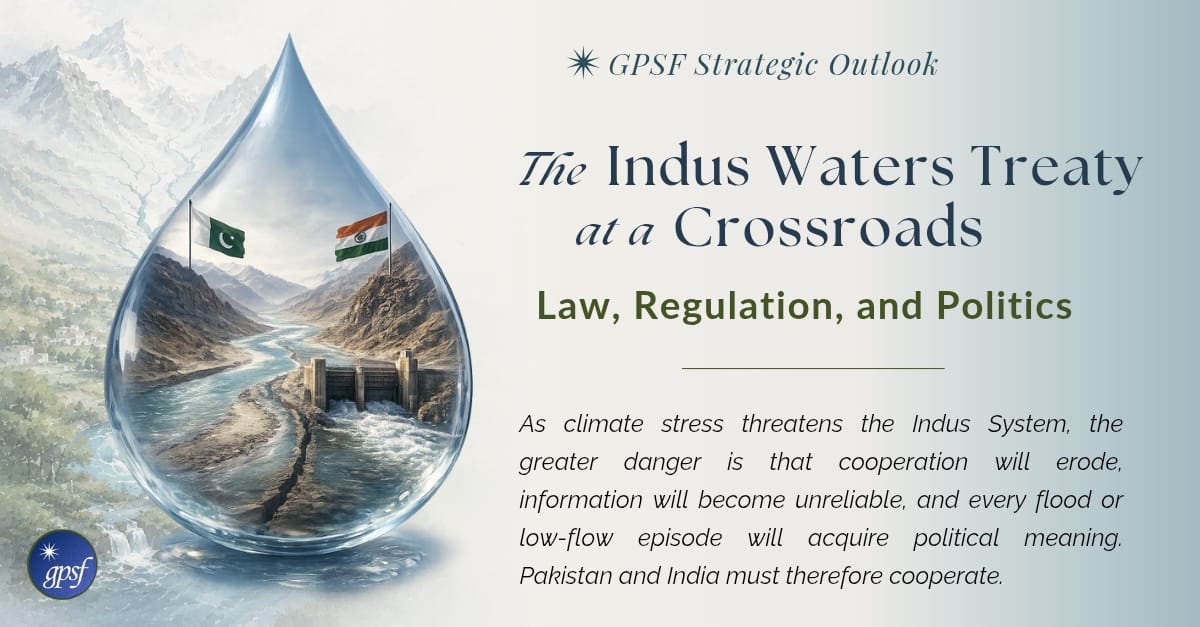
As climate stress threatens the Indus System, the greater danger is that cooperation will erode, information will become unreliable, and every flood or low-flow episode will acquire political meaning. Pakistan and India must therefore cooperate: Pakistan by defending the Treaty through law, technical capacity, diplomacy, and domestic reform; India by restoring full compliance and resisting unilateral actions that could weaken a globally recognized framework.
The stakes extend beyond water. Erosion of the Treaty would deepen mistrust, heighten miscalculation, and further destabilize South Asia. Shared rivers must remain governed by law, transparency, and institutional restraint, free from political coercion.