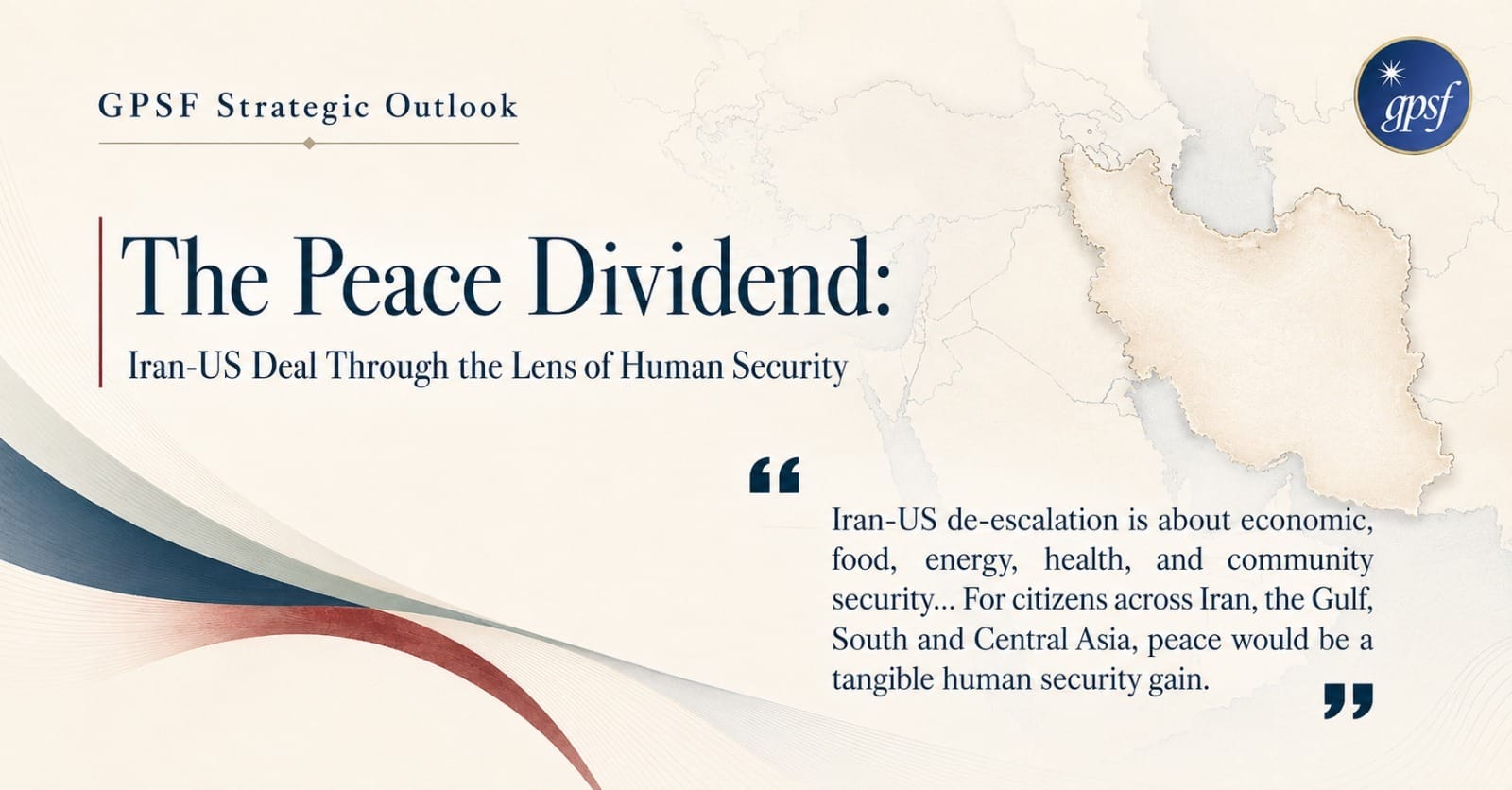
The Peace Dividend: Iran-US Deal Through the Lens of Human Security
An Iran-US peace deal is usually framed around nuclear safeguards, sanctions relief, oil markets, maritime chokepoints, and regional security. This is important, but incomplete. Traditional security focuses on states and military risks; human security asks whether diplomacy makes people safer in daily life. Seen this way, Iran-US de-escalation is about economic, food, energy, health, and community security, as well as freedom from fear.
The UNDP's 1994 Human Development Report placed people, not territory alone, at the center of security thinking. Citizens in Iran, the Gulf states, South and Central Asia, and beyond experience these effects through household budgets, employment, and access to essentials, even if they do not follow diplomatic tracks in Muscat, Vienna, or elsewhere. While the earlier articles examined the issue through a traditional security lens, this GPS Forum Strategic Outlook shifts the focus to human security, exploring in detail how it intersects with the prospects and implications of an Iran-US deal.
Energy Security
The first benefit of de-escalation would be energy stability. The Strait of Hormuz remains one of the world's most sensitive economic arteries. In 2024, about 20 million barrels per day of oil passed through it, roughly one-fifth of global petroleum liquids consumption. EIA data also shows that 84% of crude oil and condensate, and 83% of LNG moving through Hormuz, went to Asian markets, including China, Japan, and South Korea. This directly affects human security because fuel prices do not stay at petrol pumps. They shape bus fares, freight charges, electricity generation, agriculture, construction, and food supply chains. When oil becomes expensive, households pay twice: first through direct fuel costs and then through higher market prices.
Retail fuel prices illustrate the transmission to households. In the US, for example, national average gasoline prices averaged approximately $3.30-3.40 per gallon in 2024. They faced renewed upward pressure and periodic spikes above $4 per gallon in early 2026 amid Gulf-related tensions, before showing some easing in mid-2026 (EIA weekly data). Domestic policy, subsidies, taxes, and refining margins mediate these effects everywhere. Iran's heavily subsidized gasoline has remained among the world's lowest in USD terms (around $0.36 per liter in mid-2026), insulating consumers from global swings at the pump, yet broader sanctions-related pressures on the economy and currency still shape overall living costs.
Although a credible Iran-US peace deal would not end inflation, as domestic policies, taxation, exchange rates, and governance would still matter, it would reduce a major source of uncertainty in global energy markets. For energy-importing countries, that means less pressure on foreign exchange reserves, fewer sudden fuel adjustments, and a more predictable economic environment.
Food Security
Food security is also closely linked to Gulf stability. Modern agriculture depends on fuel, fertilizers, cold chains, irrigation, transport, and port operations. A crisis around Hormuz can therefore trigger food-price shocks across the Asia Pacific, the Middle East, Africa, and even Europe. Poorer households suffer most because they spend a larger share of income on food.
Global food price spikes, such as the FAO Food Price Index peak near 160 in March 2022, were driven primarily by the Russia-Ukraine crisis and related supply disruptions. Subsequent energy volatility tied to Middle East instability has added secondary pressure on input costs and logistics in import-dependent regions. Lower-income households in South Asia, parts of the Middle East, and Africa allocate larger shares of income to food and are therefore more exposed.
This is where diplomacy becomes welfare policy. Peace gives governments more fiscal space to protect vulnerable citizens. Instead of spending on emergency subsidies, expensive imports, or crisis management, states can invest in agriculture, storage, energy efficiency, and social protection. Human security improves when families can buy food without sacrificing education, healthcare, or debt repayment.
Economic Security, Connectivity, and Livelihoods
The economic security linked with connectivity is a state's foremost priority. A stable Iran-US relationship could help unlock trade corridors, such as those from Pakistan to Iran, Central Asia, Türkiye, the Caucasus, and beyond. Pakistan's ports at Karachi, Port Qasim, and Gwadar can support not only domestic commerce but also regional transit. With Iran as a land bridge, Pakistani goods can reach markets such as Turkmenistan and Uzbekistan, while Central Asian producers can gain additional access to warm-water ports.
Trade corridors create livelihoods. Truck drivers, port handlers, customs agents, warehouse operators, exporters, farmers, meat processors, fruit traders, small manufacturers, mechanics, fuel stations, and border communities all benefit when goods move legally and predictably. A peace deal that reduces sanctions uncertainty, banking restrictions, insurance risk, and investor hesitation would make these routes more viable and strengthen economic security at the household level.
When border communities earn through regulated commerce, transport, warehousing, energy trade, and services, they become stakeholders in stability. Trade alone cannot solve security problems, but it can create incentives for order. A farmer, transporter, trader, or port worker has a direct interest in peace when peace brings income. A mature security policy must therefore treat connectivity as part of stability, not separate from it. In human security terms, border communities should not be viewed merely as security peripheries, but as economic citizens.
Health Security
Ordinary citizens pay a heavy price for prolonged confrontation. Sanctions and isolation affect banking, currency stability, imports, technology access, and investment. While states may adapt, people absorb the pressure in daily life. Inflation erodes salaries, currency depreciation weakens savings, and restrictions complicate access to medicines, medical equipment, education, payments, and travel.
Sanctions and financial isolation have complicated Iran's access to imported medicines, active pharmaceutical ingredients, medical equipment, and related financing even for items subject to humanitarian exemptions. Multiple studies and reports since the 2018 reimposition of US sanctions have documented reduced availability of certain essential drugs (for cancer, epilepsy, thalassemia, and other chronic conditions), alongside currency depreciation that raises domestic prices.
A phased peace agreement incorporating verifiable commitments and sanctions relief could improve Iran's economic conditions without ignoring international concerns. The point is not to reward one side or defeat the other, but to create a framework where relief enables normal economic activity that benefits citizens. In human security terms, access to medicines, functioning hospitals, stable income, and predictable markets are as important as military de-escalation.
Community Security
An Iran-US confrontation would not remain bilateral. Its effects would radiate first across Iraq, Syria, Lebanon, Yemen, the Gulf, Afghanistan, and South Asia, before spilling into Europe and beyond. Escalation strengthens hardliners, militias, black markets, and war economies; de-escalation creates space for reconstruction, diplomacy, trade, and moderation. It would also allow regional stakeholders to pursue balanced foreign policies without being forced into unnecessary alignments. Human security improves when communities are less exposed to proxy conflict, radicalization, displacement, and fear.
Freedom from Fear
The nuclear question cannot be ignored. Any durable agreement must include credible verification, safeguards, transparency, and reciprocal compliance. A weak deal built on ambiguity would only postpone the next crisis; a strong deal would reduce the risk of military confrontation and restore confidence in diplomacy.
For common people, nuclear verification may seem remote. It is not. When nuclear diplomacy fails, markets panic, militaries mobilize, insurance costs rise, and war risks increase. People do not start wars, but they often pay the highest price for them. Human security requires freedom from want, but also freedom from fear.
A Realistic Peace
A mature Iran-US peace deal should be practical, phased, and enforceable. It must address nuclear oversight, sanctions relief, maritime security, crisis hotlines, humanitarian trade, prisoner issues, and non-interference commitments. It should also deliver early economic benefits so citizens can see that diplomacy improves daily life.
Peace lowers risk, reduces costs, opens markets, protects households, and creates alternatives to confrontation. For Pakistan, it could turn geography into opportunity by linking ports, borderlands, Iran, Central Asia, and wider markets. For Iran, it could reduce economic isolation. For the United States, the Gulf, and others, it could stabilize energy and maritime security.
The strongest argument for an Iran-US peace deal is that it would calm states and protect people. Human security begins when strategic hostility stops imposing daily costs on households, workers, patients, traders, students, and border communities. That is why such a deal is not merely a diplomatic possibility, but a peace dividend waiting to be claimed.