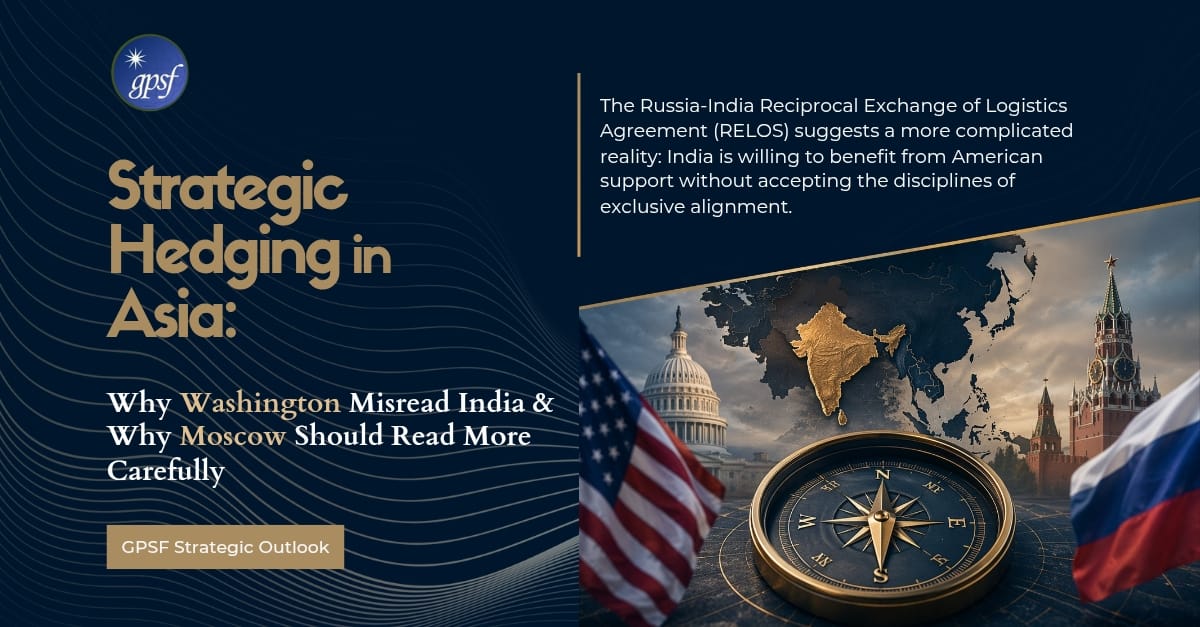
Strategic Hedging in Asia: Why Washington Misread India and Why Moscow Should Read More Carefully
The publication and public confirmation of the Russia-India Reciprocal Exchange of Logistics Agreement (RELOS) is more than a technical development in bilateral defense administration. Signed in February 2025, ratified in Russia in December 2025, and in force since 12 January 2026, the agreement reportedly allows each side to station up to 3,000 troops, five warships, and ten military aircraft on the other's territory at one time, while providing reciprocal access to military facilities and logistics support for exercises, training, humanitarian missions, and wartime contingencies. Indian reporting has compared it to the logic of logistics-sharing agreements India has concluded with other partners, though RELOS appears to go further in some respects, especially regarding deployments and the explicit wartime dimension.
What the Agreement Actually Reveals
The central policy significance of RELOS lies less in operational novelty than in what it reveals about India's strategic method. Even analysts inclined to treat the agreement as continuity rather than rupture acknowledge that it institutionalizes India's intent to preserve deep defense functionality with Russia while simultaneously expanding cooperation with the United States and Europe. That matters because it underscores a basic reality often blurred in Western strategic discourse: India is not aligning against China in the manner Washington would prefer; it is maximizing room for manoeuvre across competing poles of power.
Washington's Assumptions Under Strain
This exposes a flaw in a long-running American assumption. For much of the post-Cold War era, U.S. strategy rested on the belief that economic opening, technology access, and political courtship would gradually produce durable strategic alignment. That assumption failed first with China, which integrated into the global economy without becoming politically or strategically convergent with the West. It is now being stress-tested again with India. Washington's expectation appears to have been that India's border rivalry with China, democratic credentials, and appetite for advanced military and technological cooperation would make it a dependable counterweight in Asia.
RELOS suggests a more complicated reality: India is willing to benefit from American support without accepting the disciplines of exclusive alignment.
India's conduct is therefore better understood through the lens of strategic hedging than bloc politics. New Delhi seeks American investment, Western technology, Russian sustainment and spares, and continued economic and socio-cultural space with China, all while preserving the language and practice of strategic autonomy. India does not see itself as a junior democratic partner in a U.S.-led order; it sees itself as a civilizational power entitled to transact with all sides while binding itself fully to none. In that sense, RELOS is a document of disclosure. It makes visible a pattern that has long existed beneath the vocabulary of partnership.
Why Moscow Should Also Be Cautious
That same caution should apply in Moscow. Russia gains something tangible from RELOS: access, logistics, and a degree of Indian Ocean relevance at a time when sanctions pressure and European estrangement have narrowed its options. But Russia should avoid confusing transactional access with strategic loyalty. India is not moving back into a Russian orbit. It is monetizing Russia's residual value: Arctic access, support for legacy platforms, sustainment of systems such as the S-400, and the diplomatic symbolism of a non-Western great-power relationship.
The agreement may help Moscow operationally, but it also normalizes India's ability to draw value from Russia while continuing to diversify toward American and European systems. That is useful for India; it is not necessarily reassuring for Russia.
The Geography of Aspiration
The second part of this pattern is less military than civilizational: the geography of aspiration. A recent Wall Street Journal report notes that elite Chinese students, scientists, and professionals are increasingly choosing to remain in China or return there, citing U.S. immigration hurdles, high costs, insecurity, and a broader sense of social volatility. Chinese state media clearly amplifies these themes for domestic legitimacy. Yet the report's larger point is harder to ignore: America's appeal to some of China's most globally mobile talent is no longer automatic. This is not merely a matter of propaganda. It reflects a changing comparative environment in which Chinese cities, institutions, and research ecosystems are increasingly seen as viable sites of ambition rather than fallback options.
The Soft-Power Test
That does not mean the U.S has ceased to be a premier center of innovation, higher education, or capital formation. Nor does it mean Chinese cities have resolved their own structural problems, including uneven economic performance and demographic pressures. But it does suggest that the old imagery of the shining city upon a hill is less secure than American rhetoric often assumes. If the most talented people in a rival civilization increasingly conclude that Beijing, Shanghai, or Shenzhen can offer professional opportunity, technological ambition, infrastructure, and personal stability comparable to, or in some cases more attractive than, U.S. metropolitan life, then a significant element of American soft power is under pressure.
A Pattern Larger Than RELOS
RELOS and the shifting flows of talent point to a broader conclusion. The problem for Washington is not simply that China rose. It is that U.S. strategy has repeatedly assumed that economic access and geopolitical courtship will produce reliable political alignment. China disproved that proposition by becoming a near-peer competitor. India is now disproving it differently by accepting support while resisting exclusivity. The problem for Moscow is parallel: India may cooperate deeply, but it will not belong. Both capitals, for different reasons, risk mistaking India's transactional openness for durable strategic convergence.
The Policy Lesson
The policy lesson is straightforward. Great powers should stop reading Asia through the simplifying grammar of camp politics and start reading it through competitive hedging, selective interdependence, and prestige diversification. In such an environment, the strongest states will not be those that merely attract partners, but those that remain attractive enough that others still choose them when genuine alternatives exist. That is the real strategic test now facing Washington. It is also the question Moscow should ask before celebrating RELOS too loudly.