
GPSF Feature Story
Developments Shaping Policy Debates
Beyond Battlefield Victory: What Will Decide the Iran-United States-Israel War
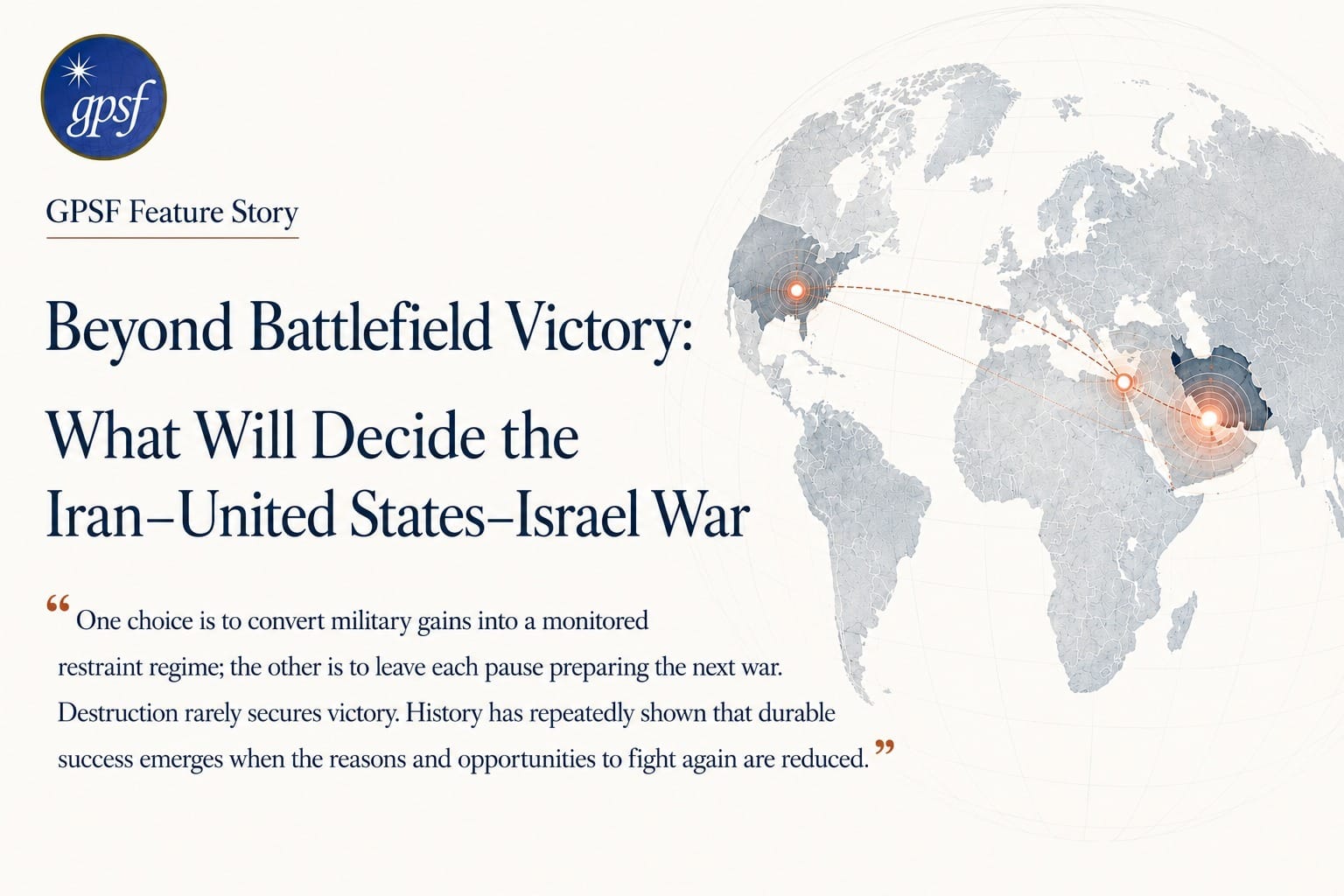
Military superiority can end a campaign without resolving the conflict behind it. This is the central problem in the Iran-United States-Israel war. Washington seeks mainly to reduce nuclear and military threats. Israel wants lasting prevention and the freedom to stop Iran from rebuilding its capabilities. Iran sees the war as a defense of its sovereignty, dignity, territorial integrity, Palestine, and civil nuclear rights against external aggression. These positions overlap only on the need for a pause that no side can exploit.
This GPSF Feature Story argues that the war's outcome will depend on five practical tests: whether Iran retains coherent authority; whether nuclear knowledge can be restored; whether military degradation can outpace reconstitution; whether governments can restrain allies and affiliated forces; and whether sanctions and maritime coercion can be exchanged for verified restraint. These tests point to four possible outcomes: guarded accommodation, armed intermission, managed transition, or cascading disorder.
The most plausible durable settlement is neither capitulation nor reconciliation, but a monitored bargain combining nuclear accounting and limited military restraint with phased economic relief, infrastructure protection, open navigation, and a mechanism to address violations before they trigger another war.
The Wrong Measure of Victory
Damage is the easiest measure, but the least decisive. Asking who destroyed more says little about how the war will end. The US and Israel hold major advantages in intelligence, air power, precision strike, and sustained operations. They have struck launchers, production sites, air defenses, ships, command posts, and nuclear infrastructure. Iran has retaliated, imposed costs on regional bases and cities, threatened shipping, mobilized support, and absorbed severe attacks.
The real test is political effect: not how much damage was inflicted, but whether it produces a more secure outcome. Military success matters only if it creates conditions more stable than those it replaced.
Coercion has limits. Iran has endured years of sanctions, UN restrictions, and US pressure. More pressure may raise costs, but it may not produce verifiable restraint and could instead strengthen incentives to resist, disperse, and rebuild.
Several questions emerge. If Iran can assure the IAEA that its nuclear program remains safeguarded against military use and keeps its military posture defensive, why should military and economic coercion remain the main tools of control? Can IAEA inspectors account for enriched uranium and sensitive equipment? Will continued force push Iran to rebuild in more dispersed and concealed forms? Can Washington restrain Israel, and Tehran its allies? Will verified Iranian restraint bring real economic relief or only new demands?
If these questions remain unresolved, a ceasefire will be only a pause between wars, not a settlement. The ultimate criterion is whether coercion can produce a settlement that is verifiable, durable, and acceptable to all sides.
This study argues that the war will be decided by whether military gains can be turned into an enforceable bargain before political cohesion, nuclear visibility, and regional restraint weaken further. Battlefield damage matters only if it creates conditions for durable restraint afterward. The analysis follows one rule: each party's stated purpose is assessed against its negotiating positions, conduct, and observable effects. Iran's own narrative, like those of the other parties, is important evidence of how Tehran defines the conflict, but not a complete account of its conduct.
The study proceeds in four steps: it defines what each party is fighting for, applies five tests of political success, identifies four plausible outcomes, and outlines the minimum bargain needed to prevent renewed war and the role Pakistan can usefully play.
The Wars the Parties Say They Are Fighting
The United States: Remove the Threat and Enforce the Result
Washington's aims are explicit: prevent an Iranian nuclear weapon, reduce missile capacity, weaken Iran's navy, and cut support to armed partners. Defense Secretary Pete Hegseth has denied that the campaign seeks nation-building or regime change.
Those aims set a clear test. If the goal is threat reduction, success cannot be measured by targets destroyed alone. Washington must explain what was missing from the JCPOA and IAEA safeguards, why those gaps could not be fixed, and how reduced capabilities will not simply be rebuilt, concealed, or replaced. It must also show how pressure will produce verifiable restraint once relaxed.
American policy extends beyond its formal objectives. Strong White House rhetoric, broad sanctions, and discussion of political change give Tehran reason to doubt that nuclear compliance alone would end US pressure. This does not prove a regime-change plan, but it matters: no agreement can endure if Iran expects each concession to bring new demands.
The US therefore faces a basic choice: does it seek a verifiably constrained Iran or a fundamentally different Iran? The first allows negotiation; the second gives Tehran reason to resist despite an unfavorable military balance.
Israel: Prevention That Lasts
Israel presents the war as existential prevention. It treats Iran's nuclear program, missiles, navy, and regional armed networks as one threat. Israeli strikes have therefore targeted nuclear and missile infrastructure, command structures, naval assets, security institutions, and reconstruction sites.
Israel's concern is not only Iran's current capability, but its ability to rebuild. Facilities can be restored, knowledge dispersed, and production moved underground. Israel will therefore seek continued visibility and a credible response if Iran crosses agreed limits.
Israel's security model clashes with Iran's. Israel wants freedom to prevent future threats; Iran wants assurance that compliance will end attacks. Unless prevention is tied to agreed limits and procedures, each side will see the other's security needs as preparation for another war.
Israeli leaders have also suggested that military pressure could enable political change in Iran. Leadership and internal-security strikes reinforce that impression. A weaker or transformed Iranian government would clearly benefit Israel, but this does not prove that regime change is its sole objective. Destroying a regime and securing the capabilities it controls are very different tasks.
Iran: An Imposed War, Resistance, and Sovereign Equality
Iran does not frame the war mainly as regime survival. It presents it as resistance to Israeli overreach and US-Israeli aggression against its sovereignty, territorial integrity, dignity, independence, and nuclear rights, while linking this resistance to Palestine and opposition to a Western-dominated regional order.
Tehran also frames the nuclear dispute as a test of whether international rules are applied fairly. It contrasts Iran's NPT obligations and safeguards with Israel's position outside the treaty and protected nuclear opacity. Iran argues that a non-nuclear NPT state has been attacked by nuclear-armed states while its safeguarded facilities and peaceful nuclear rights were under negotiation. It also cites a religious prohibition on nuclear weapons, reaffirmed by President Pezeshkian after Ayatollah Khamenei's assassination. This does not replace verification, but safeguards concerns also do not erase Iran's complaint of unequal treatment.
Iran's narrative also defines what it can accept as legitimate. Tehran presents resistance and diplomacy as complementary: resistance prevents submission, while negotiation seeks reciprocal terms based on sovereign equality. Its references to earlier negotiations and the Islamabad understanding reflect this approach.
Iranian conduct adds a harder edge. Retaliatory strikes, pressure in the Strait of Hormuz, support for partners, and resistance to unrestricted inspection serve as leverage as well as defense. They can impose costs on neighboring states that did not start the war. Iran's narrative alone does not settle the legality, proportionality, or wisdom of these actions.
Iranian conduct suggests several aims: preserving state authority, restoring deterrence, gaining sanctions relief, protecting a safeguarded civil nuclear program, and preventing another attack. These are analytical inferences, not substitutes for Iran's own account. "Regime survival" is too narrow: external attack can strengthen national solidarity without implying support for the government or ending domestic opposition.
The Region: Keep the War Out
The Gulf states do not share one view of Iran, but their immediate interest is keeping their territory, bases, ports, energy infrastructure, and sea-lanes out of the war. Gulf states have condemned attacks on their sovereignty while supporting diplomacy. Pakistan has presented the Islamabad understanding as a basis for reciprocal implementation and further negotiations. Regional states' airspace, ports, bases, energy exports, financial links, and mediation affect how long the war can continue and whether any settlement can hold. A focus only on Washington, Tel Aviv, and Tehran misses the regional actors that will bear the costs and help enforce the outcome.
Five Tests that will Decide the Outcome
Does Iran Remain a Coherent State?
The first test is whether the US and Israel let an authority accepted by Iranians to retain control over the armed forces, nuclear material, borders, ports, public administration, and negotiations. A stable outcome is unlikely if regime change is pursued under the cover of nuclear or Hormuz concerns. Leadership strikes may violate international law and undermine rational crisis management. They can disrupt operations but also weaken the authority needed to stop fighting and implement an agreement. A weak successor may compromise less, while fragmented security structures could disperse capabilities and make nuclear custodianship more uncertain.
This creates a difficult reality: states oppose Iran's government but there is still need of coherent Iranian institutions. State cohesion is not approval of the regime only; it is necessary for nuclear accounting, border control, administration, and enforceable commitments. Removing a leadership is easier than anticipating a legitimate and capable successor.
Few indicators thus emerge: do Tehran's orders still govern national forces? Are ministries functioning and salaries paid? Is there one recognized negotiating authority? Are nuclear records and personnel under accountable control? Are provincial and minority regions part of a national process or drifting toward competition? These indicators matter more than daily target counts.
Can the World Re-establish Nuclear Knowledge?
The nuclear problem is no longer only how much capacity Iran has, but how much the US and Israel are willing to accept. If Tehran intended to build a weapon, its existing or suspected enriched uranium stocks could already have enabled that despite stringent IAEA safeguards. As an NPT state, Iran has obligations but also rights. Coercing it to surrender those rights may ultimately push it toward greater use of its geographic leverages.
On the other hand, IAEA Director General reported on 8 June 2026 that in-field verification had largely stopped, access to facilities affected by the June 2025 attacks had been unavailable for almost a year, and continuity of knowledge had been lost. The Agency could not verify a previously declared stock that included 440 kilograms of highly enriched uranium (HEU). It did not say the material had been diverted or weaponized, only that its status could not be verified.
This distinction is crucial. Bombing may reduce physical capacity but increase uncertainty about surviving material, equipment, personnel, and intent. The US and Israel may then assume the worst, while Iran may disperse assets to avoid further strikes. Each side's response reinforces the other's fears.
Restoring what was not broken in the first place and knowledge of Iran's nuclear program requires a new baseline: declarations of material, components, damaged sites, debris, relocations, and reconstruction since continuity was lost. Inspectors will need access, sampling, records, interviews, and managed access to sensitive locations. The aim is to rebuild a common factual record, so disputes do not become intelligence contests.
The legal bargain also needs clarity. The NPT bars Iran from acquiring nuclear weapons and requires safeguards, while recognizing its right to peaceful nuclear use. Iran argues this includes safeguarded domestic enrichment, though that claim is contested. A durable agreement must therefore define permitted activities, stockpiles, monitoring, and consequences without denying Iran's rights or treating them as unlimited.
The US, Israel, and Iran have different legal positions. The US is an NPT nuclear-weapon state and remains bound by the treaty's disarmament obligations. It is also bound not to attack or coerce a non-nuclear-weapon state party to the NPT. Israel never joined the NPT and has not accepted its prohibition on acquisition or comprehensive safeguards rules. Iran joined as a non-nuclear-weapon state, is legally bound not to acquire a bomb. It has followed that obligation and demands its right of peaceful use of nuclear energy and an assurance that it will not be attacked or coerced either by the nuclear-armed parties to NPT or their allies. This explains the difference in treaty obligations; it does not make the order equal. Israel's non-party status is not an NPT-granted right to possess nuclear weapons, and nuclear opacity does not confer immunity or a license to use preemptive force.
Thus, the core issue goes beyond law. If NPT membership brings restraint and inspection but no credible protection from attack by nuclear-armed states, abstinence becomes harder to defend inside Iran. An unequal order can still limit proliferation only if restraint brings real security. That is why exceptionalism, nuclear accounting and protection against renewed attack must be negotiated together.
Does Degradation Outlast Reconstitution?
Destroyed capability is a wasting asset. Its strategic value declines as soon as rebuilding begins. The US and Israel report substantial damage to Iran's missile, naval, command, and nuclear infrastructure. Those reports matter, but belligerent assessments are not a complete measure of durable effect. The relevant comparison is between the rate of degradation and the rate of reconstitution. Iran can replace fixed sites with dispersal, large systems with smaller ones, direct operations with partners, visible production with concealment, and vulnerable communications with delegated authority.
Military action produces lasting gains only if the post-war order slows these adaptations. This requires monitoring, export controls, limits on selected production and deployment, and incentives for Iran to remain inside the arrangement. Otherwise, repeated preventive strikes become the strategy. Each round may buy time, but it also encourages hardening, concealment, larger inventories, and shorter decision times.
The same logic applies to Iran's pressure tactics: pressure on shipping can impose global costs but invite stronger maritime coalitions, sanctions, and attacks on Iranian naval capability. Support to armed partners can create strategic depth but weaken Tehran's claim that neighboring states must remain outside the conflict. Instruments that produce leverage in one phase can narrow diplomatic options in the next.
Can Each Government Deliver What It Promises?
The central obstacle is the fear that no party can bind the actors whose conduct matters. Iran will question whether Washington can prevent another Israeli strike; Israel whether Tehran can restrain affiliated groups and covert rebuilding; Gulf states whether US bases make them targets; and Washington whether Iranian negotiators can bind autonomous security organizations.
A useful agreement must therefore clearly assign responsibility. It should distinguish direct orders, material support, negligence, and genuinely autonomous action, and define what evidence triggers consultation, temporary countermeasures, or a material breach. Vague promises to "exercise influence" will not survive the first serious incident, like a missile, assassination, cyberattack, or disputed inspection.
Coalition differences add another layer. Washington and Israel agree on preventing an Iranian weapon but may differ on acceptable uncertainty and the duration of restraint. Gulf states seek protection without permanent entrapment in either camp. China, Russia, Türkiye, Qatar, Pakistan, and European states support different parts of a settlement and possess different forms of leverage. These differences can create bargaining space. They can also produce parallel commitments that no single actor can enforce.
Can Coercion Be Exchanged for Compliance?
An agreement will fail if verified steps bring no visible benefit. US sanctions, financial restrictions, maritime pressure, and blockade measures aim to reduce Iran's revenue and raise the cost of resistance. Iran uses navigation, oil flows, regional reach, and nuclear uncertainty as counter-leverage. Hormuz is therefore part of the bargaining structure, with disruption imposing wider energy, shipping, insurance, and fiscal costs well beyond the belligerents. The IMF and World Bank have warned of the disproportionate impact on importing and lower-income states, including Pakistan.
Is pressure reversible? If Iran provides access but receives only symbolic relief, future compliance becomes harder to defend in Tehran. If sanctions and maritime restrictions are lifted before inspectors establish a baseline, Washington and Israel will fear that relief is financing reconstruction. Sequencing must therefore be reciprocal, visible, and reversible.
This is where economic measures matter strategically. Not because "economic effects" form a separate theoretical category, but because they are the currency of implementation. An inspection visit completed, a tranche of assets released, a ship allowed to pass, or a sanction suspended is evidence that the bargain works. Without such exchanges, declarations of principle will not survive political opposition on either side.
Four Outcomes
The five tests point to four possible outcomes. These should not be mistaken for forecasts or fixed probabilities; these are pathways whose warning signs can be monitored.
| Outcome | What produces it | What it looks like |
|---|---|---|
| Guarded accommodation | Coherent Iranian authority and an enforceable bargain | Nuclear accounting, phased relief, open navigation, limited military restraint, and a mechanism for violations |
| Armed intermission | Coherent authority but no enforceable bargain | A ceasefire over rearmament, sanctions, covert action, partial inspection, and recurrent crises |
| Managed transition / Leadership change | US and Israel desired political change with recognized authority and controlled security institutions | Negotiated succession, intact administration, secure nuclear custodianship, and external noninterference |
| Cascading disorder | Fragmented authority and no enforceable bargain | Rival commands, uncertain nuclear material, regional intervention, disrupted trade, and mass displacement |
Guarded Accommodation
This is the most stable outcome still available. It requires no trust, friendship, or ideological reconciliation. Iran accepts defined nuclear limits and selected restraints; the US provides phased sanctions and maritime relief; Israel accepts a nonattack arrangement while verified conditions are met; and regional states support monitoring and deconfliction.
Each side can frame the outcome in its own language. Iran preserves sovereignty and nuclear rights; Washington gains verified threat reduction; Israel gains longer-term prevention. The narratives need not agree, but the obligations must.
Signs of progress would include sustained IAEA access, an agreed inventory baseline, limited asset releases, restored shipping, lower military alerts, and hotline use after incidents. Main risks are disputed inspections, attacks by affiliated groups, Israeli strikes outside the process, or failure to deliver promised economic relief.
Armed Intermission
This is the most likely failure mode. Major fighting stops, but the conflict remains unresolved. Iran rebuilds and disperses; Israel keeps unilateral freedom of action; the US maintains sanctions and maritime pressure; and inspections remain partial. All sides call the pause a victory and prepare for the next round.
An armed intermission may last months or years, but duration is not stability. Warning signs include temporary deals without a consolidated text, disagreement over covered actors, limited inspection access, renewed sanctions-evasion networks, recurring shipping incidents, and rhetoric that treats every violation as the end of diplomacy.
Managed Transition / Leadership Change
A managed transition is possible if a recognized authority retains state control, command chains, and sensitive capabilities. The US and Israel would prefer a friendly government, continuity of institutions and unified nuclear and missile control.
However, the bar is high. Any successor seen as imposed by foreign force may lack popular support, face nationalist resistance, and even reject US-Israeli terms more strongly than its predecessor. Outside powers should distinguish support for Iranian political choice from selecting Iran's political order. The decisive indicators are whether security forces enter a common command, whether administration continues, and whether the IAEA gains prompt access.
Cascading Disorder
This is the outcome every regional state should prevent. Central authority fragments; armed groups compete; nuclear material, records, and personnel become uncertain; peripheral regions are contested; and outside powers intervene through local partners. Maritime coercion becomes decentralized and displacement accelerates.
No party wins. The US and Israel face more numerous and less accountable threats; Iran loses effective sovereignty; Gulf states absorb attacks and economic disruption; and Pakistan faces border insecurity, refugee pressure, sectarian risk, and higher energy costs. Warning signs include rival national commands, unpaid or autonomous forces, missing nuclear custodians, conflicting shipping orders, seizure of energy infrastructure, and externally sponsored territorial factions.
The Minimum Bargain
A workable settlement should meet one test: does it close the routes back to war? Five linked arrangements are required.
A Consolidated Ceasefire
One text defines the actors, areas, and prohibited actions it covers. It bans direct strikes, assassinations, destructive cyberattacks, mining, use of third-state territory, and sabotage of protected infrastructure. It also explains how violations by allies or affiliated groups will be attributed and addressed.
Nuclear Accounting Tied to Recognized Peaceful Use
Iran provides a full baseline declaration and phased IAEA access to account for material, equipment, damaged sites, and reconstruction. The agreement defines enrichment levels, stockpile disposition, advanced centrifuge activity, and managed access. A settlement that offers Iran only prohibition will not be politically durable; one that offers rights without verification will not be strategically credible. Research on preventive attacks underscores the danger that bombing can strengthen long-term proliferation incentives even when it delays facilities.
Reciprocal Protection from Renewed Attack
Critical civilian infrastructure, including operating nuclear facilities, hospitals, dams, desalination plants, civilian ports, and key energy systems, are protected. An emergency notification channel will allow safety access after an alleged violation. The IAEA has reported attacks without off-site radiation release in particular incidents, but that cannot be treated as assurance that future strikes will remain contained.
Israeli nuclear disarmament cannot be a precondition for an Iran settlement. But Israel's nuclear opacity and relevant long-range capabilities cannot remain permanently outside regional discussion if Iran is asked to accept indefinite nuclear restraint. A parallel process can address legally binding security assurances for non-nuclear states, protection of safeguarded facilities, and gradual movement toward a Middle East zone free of nuclear and other weapons of mass destruction (WMDs).
A Middle East free of nuclear, chemical, and biological weapons should be the end state rather than the starting point. The immediate bargain should not wait for that process but help create and sustain it.
Compliance for Relief
Humanitarian and civilian safety measures can begin immediately. Wider relief on oil, banking, insurance, shipping, and frozen assets should follow verified steps. Assets can be released in stages, while snapback must be proportional, reversible, and subject to quick review of disputed findings. Sanctions outside the agreement must be clearly identified; hidden conditions will undermine confidence.
Open Navigation and Bounded Military Restraint
The Strait of Hormuz returns to nondiscriminatory passage, supported by mine removal, safe-transit channels, incident-at-sea procedures, and monitoring by affected coastal and trading states. Initial military measures must focus on conduct rather than comprehensive disarmament: notification of major exercises, restrictions on attacks from third states, selected nondeployment zones, and limits on transfers during implementation. Broader missile or partner-force limits will require credible protection for Iran against attack and regional discussion of Israel's relevant capabilities.
These arrangements need an implementation body with political, technical, and deconfliction channels. The IAEA should retain authority over safeguards findings. Political guarantors should not rewrite technical conclusions, and technical disputes should not automatically authorize war. Alleged violations should first trigger fact-finding, consultation, and proportionate interim measures, except in response to an actual armed attack.
The parties' legal positions will remain contested. The UN Charter prohibits force against the territorial integrity or political independence of states but permits self-defense after an armed attack. Legality depends on necessity, proportionality, attribution, and the status of targets, not on a belligerent's claim alone. Security Council Resolution 2817 condemned Iranian attacks on neighboring states and upheld navigational rights but did not validate all earlier US or Israeli actions. Nor did the initial resort to force legalize Iranian attacks on states not responsible for it. A settlement can preserve these legal claims while setting rules for the future.
Pakistan's Role: Make the Bargain Work
Pakistan's value lies in turning competing narratives into negotiable obligations. Iranian "resistance" can be expressed as requirements for non-attack, sovereign equality, sanctions relief, and safeguarded nuclear rights. US "enforceability" can mean declarations, access, timelines, and proportionate consequences. Israeli "prevention" can be expressed as verified thresholds and an agreed response process rather than indefinite unilateral discretion. Gulf "strategic autonomy" can be expressed as protected territory, open sea-lanes, and non-use of regional states as platforms or targets.
Empirical evidence exists that Pakistan is well placed for this role. It has longstanding ties with Iran, the US, China, Saudi Arabia, Türkiye, Qatar, and other Gulf states, while sharing a vulnerable border with Iran and depending on secure energy flows and sea-lanes. Pakistan can understand Iran's concerns about unequal treatment while still working within international institutions. This allows Islamabad to engage Iran's concerns without endorsing every Iranian action, and to support verification without supporting permanent coercion.
The role should remain practical: consolidate ceasefire terms in one text, link verified steps to corresponding benefits, keep political and technical channels open during rhetorical crises, coordinate Gulf, Chinese, Turkish, European, and Russian support around one process, and promote regional cooperation on trade, energy, transit, and border security without being seen as a new bloc.
Pakistan cannot replace the IAEA, finance reconstruction, guarantee Israeli restraint without Washington, or accept responsibility for actors it does not control. Its role must be measured more narrowly: whether it keeps negotiating channels alive, clarifies commitments, detects noncompliance early, and prevents disputes from triggering another war. Public Pakistani statements on the Islamabad understanding, together with support from Türkiye, KSA, Qatar, Oman, and China, provide a basis for such a role.
Conclusion
The Iran-US-Israel war is unlikely to be decided by the largest target or sanctions list. It will be decided by what survives the fighting and what can be built around it.
Iran's own account of the war must be understood before it is interpreted. Tehran says it is resisting aggression and defending sovereignty, dignity, territorial integrity, Palestine, and its claimed nuclear rights under NPT. This does not excuse every Iranian action but explains why capitulation will not produce a durable settlement. Washington's stated goal of bounded threat reduction must likewise be weighed against coercive policies suggesting wider political aims, including political change. Israel's preemptive approach, which it presents as preventive, must be weighed against the instability created if prevention becomes an unlimited license to strike.
This exposes a wider test of the nuclear order. Iran is legally bound not to acquire a bomb. The question is whether that restraint can remain sustainable while Israeli nuclear opacity is accommodated.
Five issues now carry more strategic weight than another round of battlefield claims: coherent authority in Iran, restored nuclear knowledge, restraints that outlast rebuilding, governments able to deliver on agreements, and a credible exchange of compliance for relief. If these hold, guarded accommodation is possible. If not, the result may be armed intermission or, at worst, cascading disorder.
"One choice is to convert military gains into a monitored restraint regime; the other is to leave each pause preparing the next war. Destruction rarely secures victory. History has repeatedly shown that durable success emerges when the reasons and opportunities to fight again are reduced."