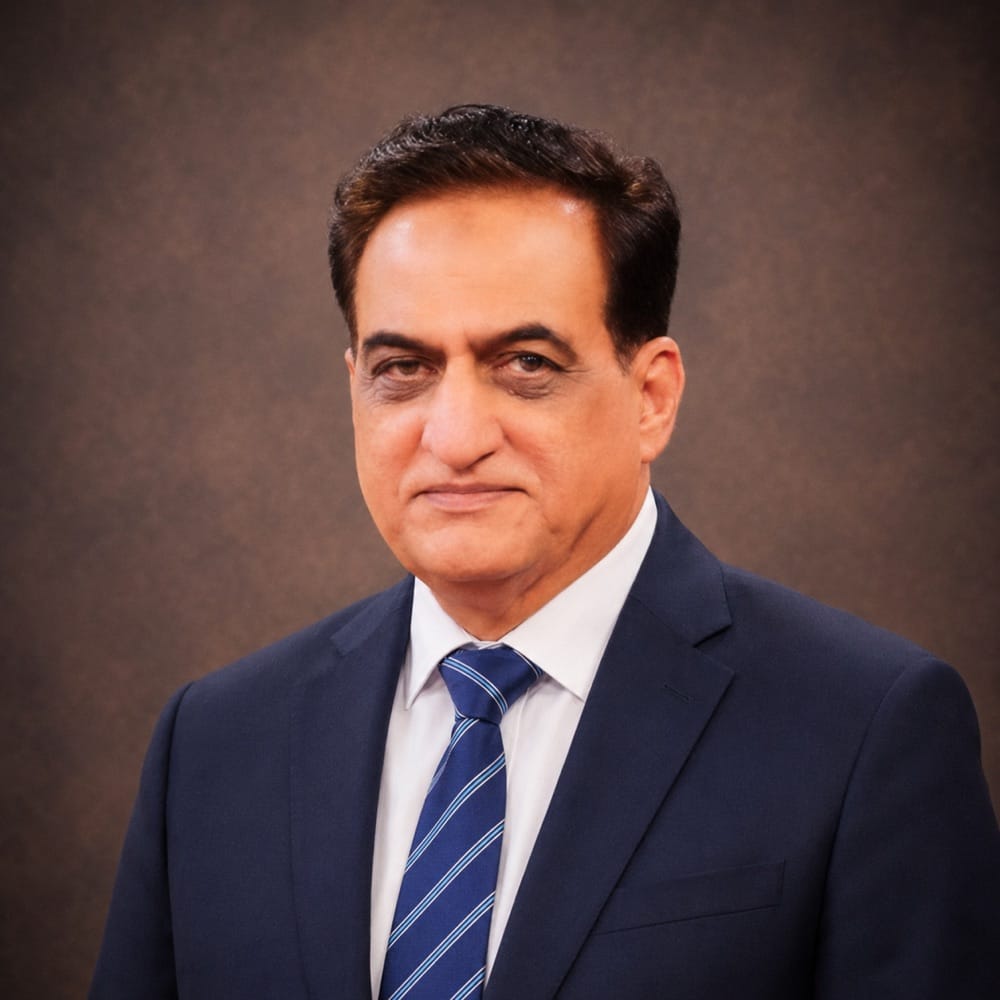
Vice Admiral Dr. Ahmed Saeed, HI(M) (Retd)
Former President, National Institute of Maritime Affairs (NIMA), Bahria University
Pakistan Navy (Retd)
Vice Admiral Dr. Ahmed Saeed, Hilal-i-Imtiaz (Military), is a distinguished maritime strategist and former senior officer of the Pakistan Navy, with more than four decades of experience in operational command, joint warfare, strategic planning, defense acquisition, international diplomacy and institutional leadership.
He has served as Chief of Staff to the Chief of the Naval Staff, overseeing key administrative, strategic and operational functions of the Pakistan Navy. His expertise encompasses maritime security, public policy, the blue economy, naval diplomacy, climate resilience and the development of national maritime institutions.
During his naval career, Vice Admiral Saeed held several important command, staff and project-management appointments. He served as Deputy Chief of Naval Staff (Projects-II), Assistant Chief of Naval Staff (Operations), Director General Joint Warfare and Training at Joint Staff Headquarters, and Commander of the Pakistan Navy's Submarine Squadron.
His extensive experience in strategic defense acquisition included serving as Chief Project Director for the Chinese submarine acquisition program and as Head of Mission in France for the Agosta 90B submarine project. These assignments involved complex international negotiations, government-to-government coordination, strategic asset accountability, and the management of major national defense projects.
From 2022 to 2025, he served as President of the National Institute of Maritime Affairs (NIMA) at Bahria University, Islamabad. Under his leadership, the Institute was restructured into six specialized centers and 41 research desks, substantially strengthening its capacity for maritime research, policy analysis, and national outreach. He played a leading role in the formulation of the National Maritime Policy and the Pakistan Shipping Policy 2024, while advancing policy discourse on green shipping, sustainable ship recycling, fisheries, coastal tourism, marine biotechnology, renewable energy and Pakistan's wider blue-economy potential.
Vice Admiral Saeed has represented Pakistan at major international forums, including COP29, the Beijing Xiangshan Forum, AMAN Dialogue, the IISS-NESA South Asia Security Forum, the LIMA Maritime Conference, and maritime and ocean-governance engagements in China, the United Kingdom, Norway, South Korea, and Southeast Asia. He has also contributed to building institutional partnerships with the International Maritime Organization (IMO), International Labor Organization (ILO), Japan International Cooperation Agency (JICA), Food and Agriculture Organization (FAO) and International Committee of the Red Cross. His academic and policy engagements have included keynote addresses and lectures at the National Defence University (NDU), Pakistan Navy War College (PNWC), Bahria University, Fudan University, the Shanghai Institute of International Studies (SIIS) and several other national and international institutions.
Vice Admiral Saeed has co-authored publications on environmentally sound ship recycling, the law of the sea, South Asian maritime security and strategic stability. He regularly contributes articles to national and international publications and participates in television discussions and podcasts on evolving geopolitical, geostrategic, and maritime developments.
He is a graduate of the PNWC, the NDU in Islamabad and the Command and Staff College in Nanjing, China, and has undertaken specialized submarine-warfare training in France.
In recognition of his distinguished military service, he was awarded the Hilal-i-Imtiaz (Military), Sitara-i-Imtiaz (Military) and Tamgha-i-Imtiaz (Military). In 2025, the Netherlands Maritime University College, Malaysia, conferred upon him an honorary doctorate in Maritime Management in recognition of his contributions to Pakistan's maritime sector.
Vice Admiral Saeed's association with the GPS Forum adds significant value to its focus on maritime security, strategic stability, the blue economy, climate resilience, international diplomacy and informed public-policy development.