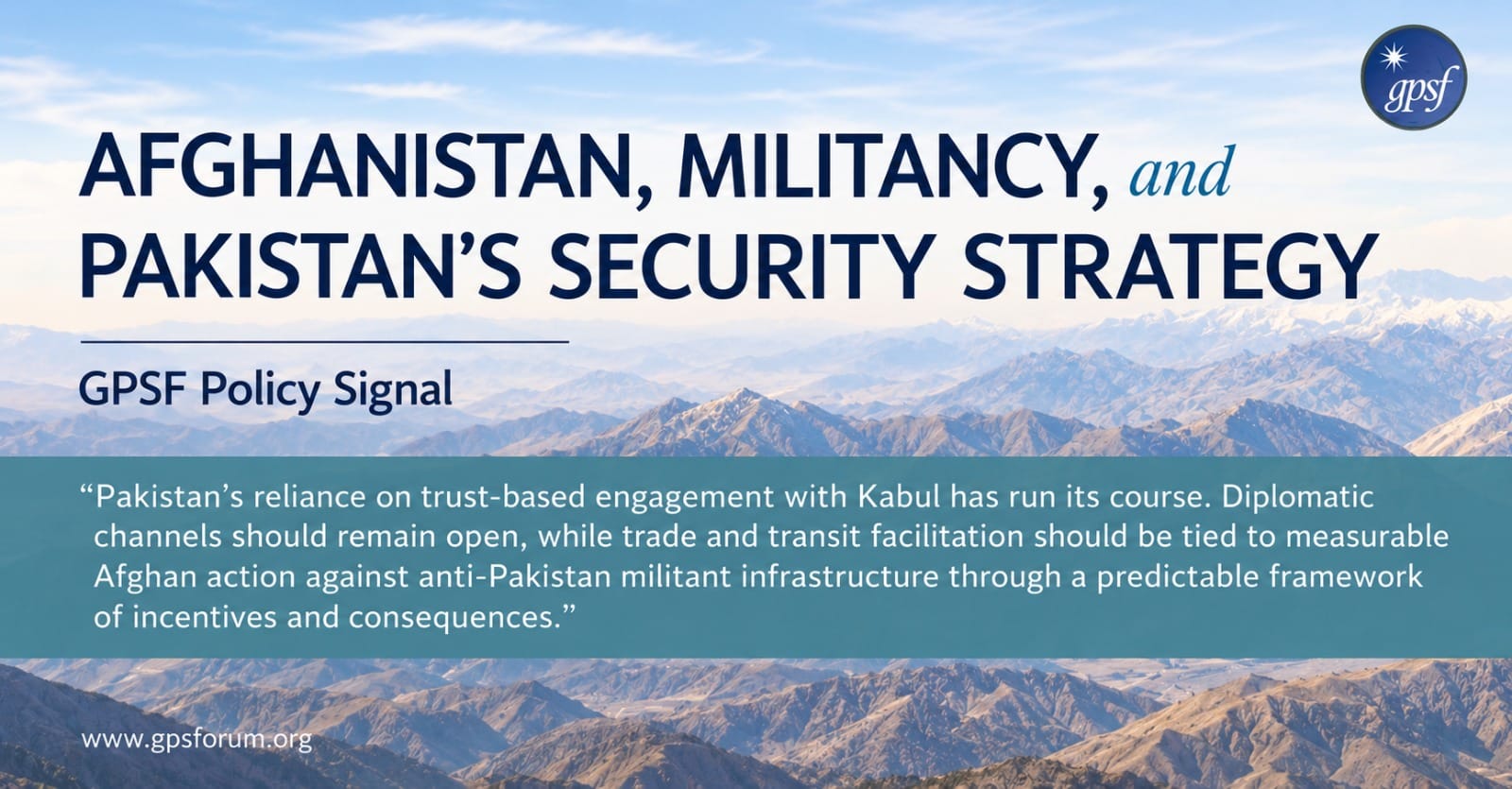
Afghanistan, Militancy, and Pakistan's Security Strategy
Pakistan faces a persistent and complex security threat emanating from Afghanistan, shaped by an Afghan interim government reluctant to act decisively against anti-Pakistan militants; militancy expanding from physical sanctuaries into propaganda, recruitment, and digital operations; more assertive Indian interference; and governance gaps at provincial levels that allow militant networks to develop social and operational roots. These factors increasingly reinforce one another, requiring an integrated strategy. The central policy question is how Pakistan can prevent instability and militant infrastructure across its western border from translating into instability at home.
The Post-2021 Scenario
The expectation that the Taliban would be more responsive to Pakistan's cross-border security concerns has steadily eroded since 2021, with Fitna al-Khawarij expanding its use of Afghan territory for sanctuary, training, and cross-border movement. The UN Security Council's Thirty-eighth Monitoring Team report of 10 August 2026 states that the de facto Taliban authorities continued to support TTP as the group intensified attacks against Pakistan, contributing to escalating cross-border military exchanges. The first seven months of 2026 saw Pakistan's highest militant-related toll since 2023.
Pakistan's February 2026 cross-border operation, Ghazab lil-Haq, was followed by intermittent border closures and further strikes. In March, Islamabad strongly rejected Afghanistan's claim that the strikes had hit a hospital, proving that the target was a militant ammunition depot and citing subsequent secondary explosions.
Kabul rejects Pakistani concerns over militant sanctuaries, framing terrorism as an internal matter and invoking Afghan sovereignty. Islamabad's position is reinforced by UN assessments identifying the TTP as a major terrorist group operating from Afghanistan with greater freedom and support. Sustained cross-border attacks therefore make this an external security concern for Pakistan and place responsibility on Kabul to prevent Afghan territory from being used against it. The resulting impasse is reflected in recurring border tensions, military exchanges, and limited bilateral progress, while also exposing the limits of a strategy dependent on changes in Kabul's behavior.
How External Sanctuary Converts into Internal Pressure
Three concerns increasingly intersect.
First, India's diplomatic footprint in Kabul has expanded, with its mission upgraded to an embassy in October 2025 and the Taliban appointing a chargé d'affaires in New Delhi in January 2026. India presents its engagement as regional cooperation, but its growing presence carries security implications for Pakistan, which has documented and shared evidence with UN and international bodies about Indian support to terrorist proxies operating against Pakistan, including from Afghan territory. In this context, deeper India-Afghanistan engagement amid strained Pakistan-Afghanistan relations warrants close scrutiny.
Second, the militant threat now extends beyond physical sanctuaries into information, recruitment, and technology. The dedicated drone unit of Fitna al-Khawarij and systematic use of attack footage for propaganda show an organized effort to expand ideological reach alongside operational capability.
Third, governance and development gaps in KP remain the area most directly within Pakistan's policy control, with financial management and resource allocation largely resting with the provincial government. By mid-2026, KP police sought an additional Rs8 billion to sustain infrastructure and CTD deployments. Resource constraints, uneven policing and justice-sector weaknesses reduce state responsiveness and allow militant networks greater room to recruit, regroup, and sustain local support.
Regional Landscape
These internal and cross-border pressures coincide with a broader regional recalibration around Afghanistan, where China, Russia, Iran, the Gulf states and Central Asian neighbors all have direct stakes in stability.
China has remained closely engaged through bilateral diplomacy and the China-Afghanistan-Pakistan trilateral mechanism. The sixth Foreign Ministers' Dialogue in August 2025 and the Urumqi talks in April 2026 emphasized counterterrorism, regional stability and sustained dialogue, with terrorism remaining central to Afghanistan-Pakistan relations.
Russia has also deepened engagement with Kabul, expanding economic ties in trade, transport, energy, and infrastructure, while continuing to view terrorism from Afghanistan as a regional security concern. Through the Moscow Format and CIS security frameworks, it has pressed for stronger counterterrorism cooperation and measures to prevent Afghan territory being used against neighboring states.
Iran's approach combines border security and trade with concern over militant spillover, while maintaining direct engagement with Kabul on refugees, water, and cross-border stability.
The Gulf states, particularly Qatar and the UAE, have emphasized diplomatic engagement, humanitarian support, and economic connectivity, with Qatar continuing to provide a platform for dialogue on Afghanistan.
Central Asian states increasingly view Afghanistan as both a security concern and a connectivity corridor, with Uzbekistan promoting trade, transport, and energy links between Central and South Asia.
The Shanghai Cooperation Organization (SCO) has provided a broader regional framework for these concerns, with its Regional Anti-Terrorist Structure in 2026 highlighting terrorist threats emanating from Afghanistan and calling for stronger cooperation on counterterrorism, border security, information-sharing, and extremist use of cyberspace.
Future Policy Priorities
As argued in an earlier GPSF Strategic Outlook, Pakistan's reliance on trust-based engagement with Kabul has run its course. Diplomatic channels should remain open, while trade and transit facilitation should be tied to measurable Afghan action against anti-Pakistan militant infrastructure through a predictable framework of incentives and consequences.
The second track must reduce the domestic space through which external sanctuary produces effect. Counterterrorism must extend beyond kinetic measures to governance. Strengthening CTD, border management, and police capacity should be matched by improved district administration, intelligence coordination, and credible local political engagement. The National Counter Terrorism Authority (NACTA) must function as the central federal-provincial coordinating hub, building on the recent National Prevention of Violent Extremism Policy (NPVE) 2024.
NACTA must evolve into a national counterterrorism assessment and performance hub, drawing on models such as the UK's Joint Terrorism Analysis Centre and the US National Counterterrorism Center. It should maintain a unified threat picture, integrate federal and provincial intelligence inputs, identify capability and implementation gaps, conduct periodic red-team assessments, and link threat evaluation to CT priorities and resource allocation. Its value should lie in coordination and identifying where the chain from external threat to domestic vulnerability remains intact.
The third track is regional. Pakistan must complement stronger domestic CT institutions with a structured regional approach, using existing bilateral, trilateral, and multilateral mechanisms with China and other regional partners to develop shared threat assessments, monitoring arrangements, and clearer counterterrorism commitments, while linking connectivity and transit opportunities to improved security cooperation, to translate regional convergence on Afghan stability into a more coordinated security framework.
Pakistan already has multiple Afghanistan-focused channels, including Foreign Office-led diplomacy, inter-ministerial consultations, national-security forums and bilateral mechanisms. The need is therefore for tighter integration. An existing national-security forum could periodically review the western security file through a small interagency working group combining diplomatic, military, intelligence, economic, and provincial inputs, with NACTA supporting threat assessment and implementation monitoring.
Conclusion
Pakistan has already adopted a firmer strategy through engagement, cross-border counterterrorism action, regional diplomacy, and improved internal CT capacity. The next phase must shift from managing individual crises to reducing the strategic utility of Afghan-based sanctuary through stronger governance in KP, better national threat assessment and coordination, measurable conditionality with Kabul, and deeper use of regional mechanisms where interests converge.
The central task is to disrupt the link between external sanctuary and domestic insecurity by limiting how militant infrastructure translates into recruitment, mobility, influence, and violence inside Pakistan. Success should therefore be measured by both the pressure Pakistan generated on militant infrastructure across the border and Pakistan's ability to contain its domestic effects.
Strategic patience will remain necessary, as progress is more likely through cumulative gains in border control, network disruption, provincial capacity, and regional coordination than through any single diplomatic or military breakthrough. That would shift Afghanistan policy from managing Kabul's choices to securing Pakistan's western strategic space.